
First – STEM doesn’t have to be technology. It doesn’t have to be stand-alone. It doesn’t have to be complicated. We also don’t have to do STEM alone. STEM can essentially be fused into virtually any lesson.
The challenge of STEM is to see if we can combine two or more subjects or two or more disciplines into one lesson. The best way to explore how we can find that “sweet spot” of true STEM education is by following the TPACK model approach to lesson design.
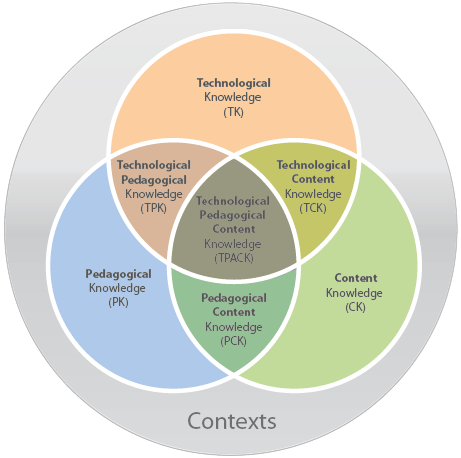
CommonSenseMedia has a nice video outlining how the TPACK model works:
Teachers are experts at the Content and Pedagogy areas of the TPACK Model. We know and understand the best practices of how to reach our students in a developmentally appropriate way, in order to deliver relevant content according to our subject area. Some of us need some assistance to introduce the Technology component to the lesson.
We need to be careful, though, and not assume that adding any technology is going to revolutionize your classroom. Replacing a chalk board with a SMART board might seem revolutionary to you, but it’s how you use the technology that really makes your lessons fly. If your students are just writing answers on the board, the only benefit to a SMART Board is the ability to save the notes for later. But, if your students are solving puzzles, connecting to the community, or creating digital content, then your lessons are upping their game.
Fusing your lessons
To model a way to fuse multiple curriculums into one lesson, I designed a small unit for first grade that combines Science, Technology with Math and Social Studies.
Overall, the students will learn about the life cycle of plants. The Science portion, the students will study the parts of a plant, and phases of it’s life cycle. The students will also grow their own seeds in the classroom. The Math portion of the lesson, the students will use rulers to measure plant growth, and record the growth on a chart. The ELA portion of the lesson focuses on connections between a book, and the real world. And lastly, the Social Studies portion of the lesson, the students will learn how humans modify the world around them.
Oh, I didn’t forget about the technology either! While the students are waiting for their seeds to grow, they will create a stop-motion animation video with construction paper and an iPad to model seed growth.
None of these ideas are new. They just fuse together nicely to create an interactive unit for students to learn life cycles of plants with hands-on experiences, discussion, collaboration, and fun!
The students do not have to sit in an ELA class to read the book. They do not have to sit in a Science class to learn about plants. They do not have to sit in a Social Studies class to learn about the world around them, and lastly, they do not need to measure in Math class alone, without making connections to the real world. All of this can be combined into fun projects that break down walls (silos) within our schools.
To download the lesson, click HERE.
 Building Up STEAM