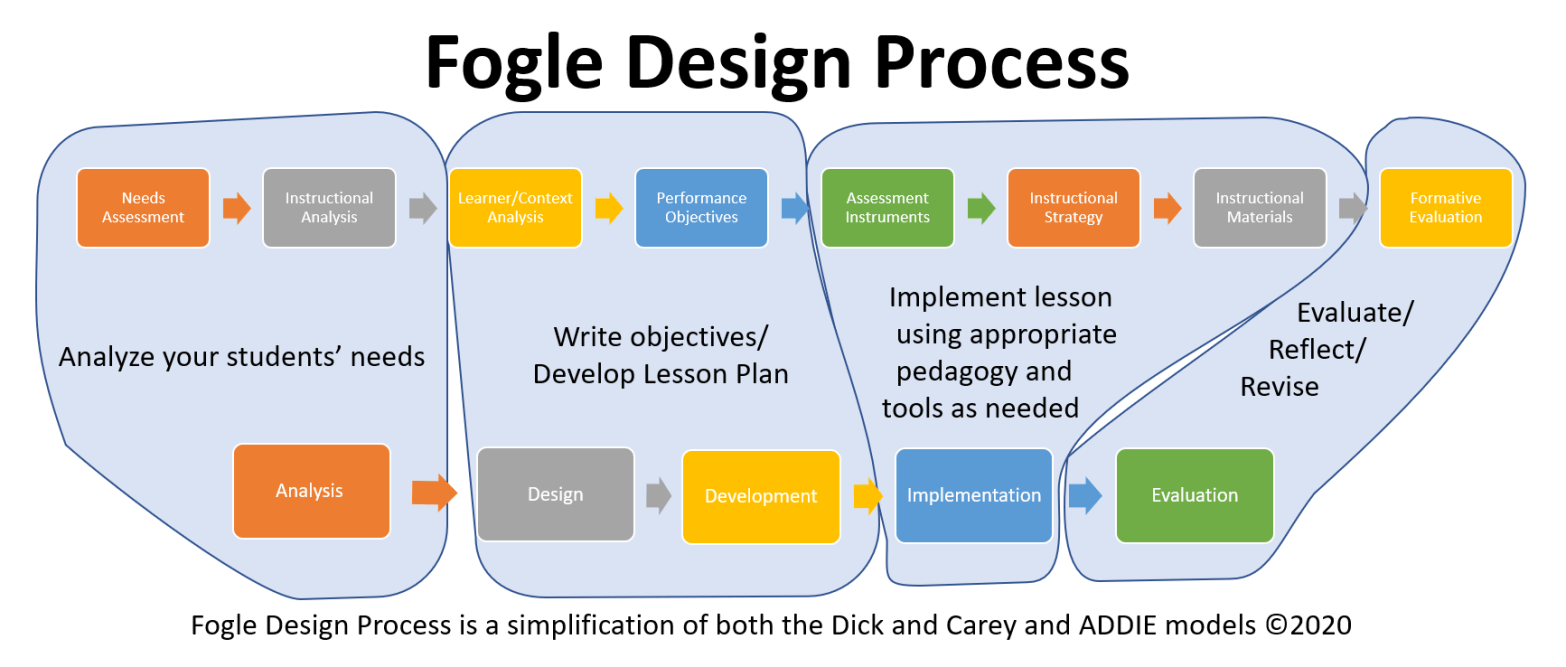
Considering that the ADDIE Model has been around since 1975 and the spin-off version, the Dick and Carey Model has been around since 1978 says something. Even though these models have been around for over 40 years they are still relevant to educators today.
The ADDIE Model is a design process that asks learners to follow a cyclical design process where you Analyze the needs of your students, Design objectives, Develop lesson materials, Implement the lesson and Evaluate student learning (rinse, lather, repeat).
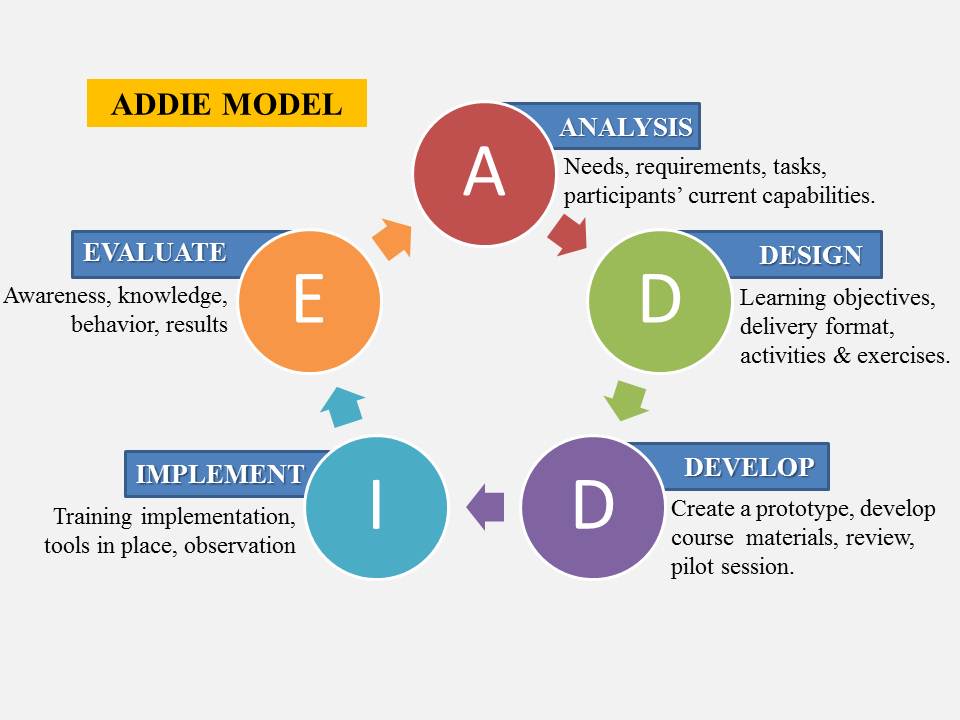
The Dick and Carey Model is a variant of the ADDIE Model. Educators first identify instructional goals by analyzing what is needed and identifying the student’s current abilities. Educators then write Performance Objectives, Develop Tests, Develop Instruction Strategy and Develop the Instructional Materials. Lastly, they form the Formative & Summative Evaluations and revise instruction as needed.

Now, if I haven’t put everyone to sleep yet, then I haven’t done my job. If you’re a teacher in the “real world,” these processes can be overwhelming. We ain’t got time for that!
The Fogle Design Process
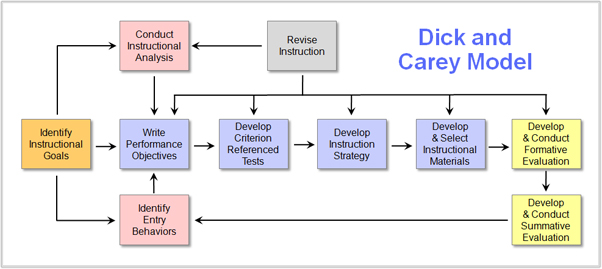
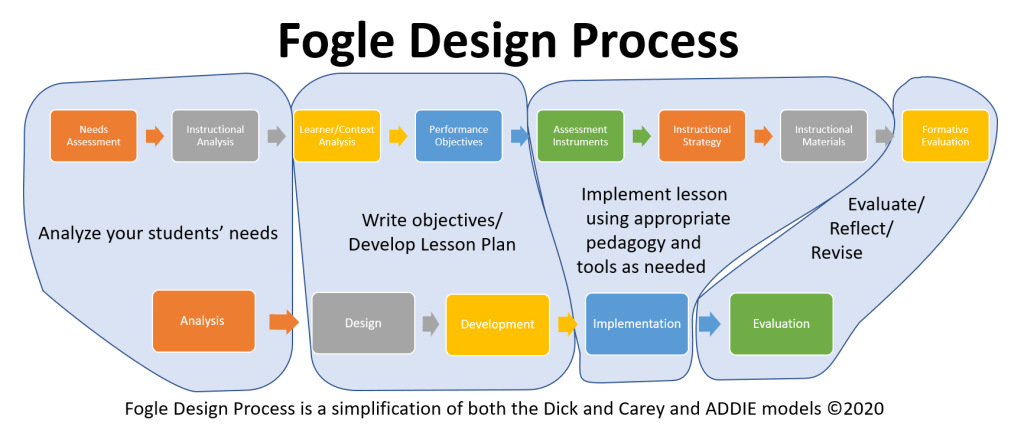
That’s where the Fogle Design Process comes in! I’ve combined the 13 steps of the Dick and Carey and the ADDIE Models into four condensed steps that most educators will have time to implement.
- Step 1: Analyze your students’ needs.
- Knowing your students’ needs is a basic requirement for all educators. Just “covering” the curriculum is not enough. Every classroom is different, lessons need to be designed accordingly.
- Step 2: Write objectives/Develop Lesson Plan
- Having goals and objectives stated in lessons is a must for good lesson design. Educators are experts in designing lessons that fit the needs of their students, so this step is very natural.
- Step 3: Implement lesson using appropriate pedagogy and tools as needed
- Implementation of the lesson using the appropriate pedagogy and tools, is also very natural to educational professionals.
- Step 4: Evaluate/Reflect/Revise
- Reflecting on our lessons is something that some teachers fail to enact faithfully. It is imperative that we think back on the lesson, revise it for the future and re-implement as needed later.
Most teachers learn about these and other different design processes during their undergraduate days. After 10 to 20 years in the classroom, many of these design processes seemingly go “out the window.” It may appear like this on the outside, but the reality is, as educators, we are too professional to just ignore true design processes. The experience in the classroom that we carry on our shoulders makes these design processes integral to our lesson designs. They are automatic.
It has been many years since I pulled out a formal “design process” sheet and designed a lesson according to the strict process guidelines. But, reflecting back on my own lesson design process, I discovered that I still faithfully execute these steps in my own way, because they’re so automatic and ingrained into my educational well-being!
I’m not expecting the Fogle Design Process to hit mainstream, but it is here to highlight that if we keep doing what we’re doing in the classroom – especially what comes naturally to educators, we’ll do just fine in the real world.
 Building Up STEAM